
Sixth Grade Easter
A couple reflections on this Grand Sunday, courtesy of my students

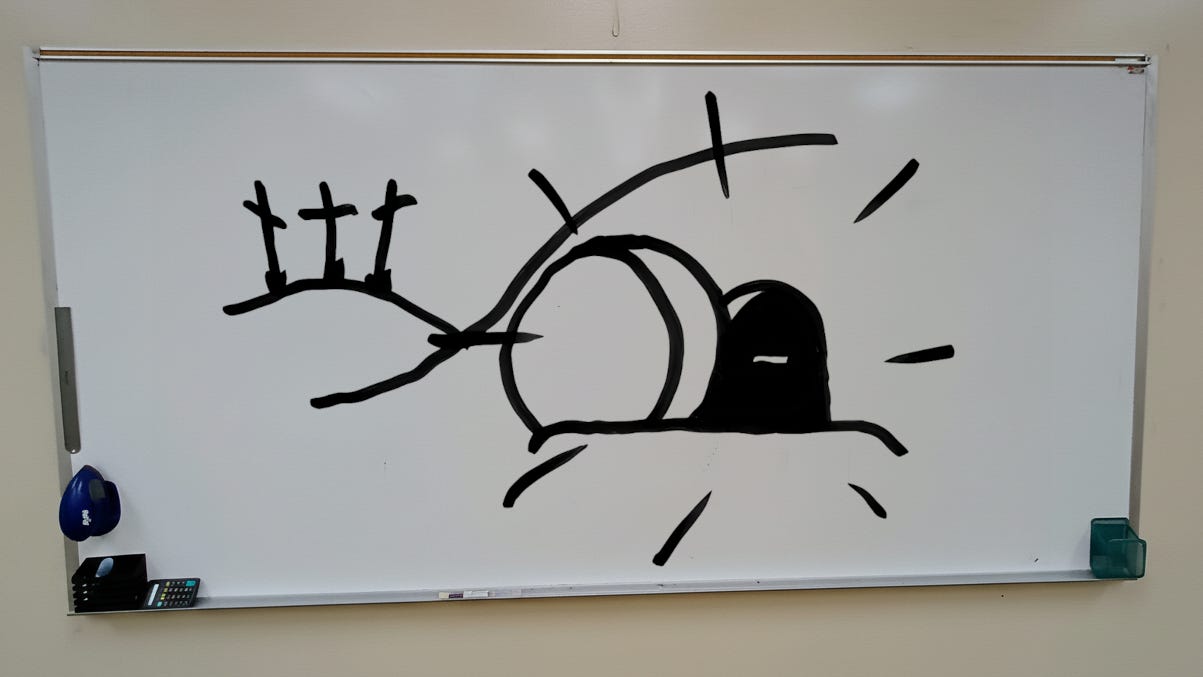
Happy Easter to all! Christ is, if you haven’t heard yet, risen from the dead, which is very good news. As you contemplate this most glorious of feast days, I want to pass on a couple of healthy thoughts that my students have brought to mind about Christ’s Resurrection in the last few weeks.
The first student contribution comes from a recent test on 1 Peter. We had noted while reading that Peter applies “through the resurrection of Christ” both to our being born again and to the sentence about baptism now saving you. On the test, I asked both to what event Peter had connected these things and, more speculatively, why he made that specific connection. There were several generic answers, a few that simply tied them together by appeal to Christ’s death as something connected with the resurrection, and a couple more decent answers that connected rising from the water with rising from the dead. But one was slightly more interesting and complete: she went further than the rest to speak of the necessity of Christ conquering death to our salvation, while also making the link that rising from the dead is itself like a new birth.
As ChatGPT would say, “You’re exactly right!”
To her first point, Easter reminds us that death itself needed to be conquered. A salvation that was purely forgiveness of sins without also a conquest of death would be, besides flatly absurd, deeply incomplete and inconsistent with how God made us. God formed our bodies from the dust, breathed into them the breath of life, and intends to immortalize them with the glory of the stars. God did not provide only pardon; on the basis of that pardon, He gave us a new life, not only metaphorically, but also literally as our inheritance, first in Christ our Head, and one day in our own bodies.
Beyond this, as the Apostle Paul reminds us, Christ was raised from the dead by the power of the Holy Spirit, who now lives within us and fills our mortal bodies with that same resurrection power. Per Romans 8:11, “But if the Spirit of Him who raised Jesus from the dead dwells in you, He who raised Christ from the dead will also give life to your mortal bodies through His Spirit who dwells in you.” Furthermore, as the dear child said, rising from the dead is itself like a new birth, thus Christ is called the firstborn from the dead.1 Our own regeneration is, as it were, the incorruptible2 seed in us of the new life that will one day mature into a whole incorruptible existence.3
I do wonder if this child even knew how well she nailed this question. Probably not, TBH.
The second observation, of a rather different sort, comes from the interrogations of another and rather insatiable mind in my class. As we read Hebrews and reached chapter 2, I tried to draw the class’s attention the importance to its argument that Christ ascended as a man to the throne of the universe: a real human being ruling the world with a real and immortal human body. Fortunately and delightfully, this almost immediately provoked a beautiful question: if Jesus ascended into heaven with His human body, does this mean heaven must be a kind of a “physical place?” And, of course, I had to tell them that the answer must be a kind of “yes,” however little we know about the details. This led to a very fun opportunity to discuss Lewis and The Discarded Image, but I digress.
The real and fascinating point is precisely this: that Jesus still bears an actual body, the self-same body that was pierced in hands, feet, and side, with scars to prove it. It was this crucified flesh and bones that God raised to new life on Easter Sunday, and in the same manner, we shall rise with the same bodies in which we die in the Lord. The future is bodily, and our eternal home will not be intangible and ethereal but a suitable home for bodies. Though they will be changed, and gloriously so, bodies they will remain, and the human form in all its oddness and limitation forever dignified and exalted. In the meantime, Jesus is somewhere in His glorified flesh, standing or walking or sitting or whatever He is doing with a head and hands like ours, actually being tangible. He is not a phantom or pure spirit or invisible but remains one of us with a concrete field of view, set of sensations, auditory landscape, etc. What it is like for Him we shan’t know until our own resurrections follow His, but in the meantime, it is a jolt to the imagination to comprehend exactly how much it means that He in His crucified flesh conquered death and lives, never to die again.
So, the next time you said, “He is risen indeed!” perhaps stop and give a thought to these sixth grade observations, let them fortify your imagination for the love of Christ, and perhaps give thanks for God’s ongoing kindness to a teacher and his students in one little classroom of 12-year-olds.
Colossians 1:18, Revelation 1:5.
1 Peter 1:23.
1 Corinthians 15:51-53.